
 Chamber 1
Current role: Assistant Professor of Colorectal Surgery, Shaheed Suhrawardy Medical College & Hospital, Dhaka
Dr. Muhammad Nazrul Islam
MBBS, BCS (Health), FCPS (Surgery), MS (Colorectal Surgery) FACS (USA)
Colorectal General & Laparoscopic Surgeon
Assistant Professor, Department of Colorectal Surgery
Shaheed Suhrawardy Medical College & Hospital, Dhaka
Colorectal Surgeon in Dhaka | FACS (USA) | Dr. Nazrul Islam
Best Colorectal Surgeon in Dhaka | 20+ Years Experience | 50,000+ Surgeries
Dr. Muhammad Nazrul Islam is a colorectal surgeon in Dhaka with more than 20 years of surgical experience. He treats problems of the anus, rectum and colon, along with common general surgery conditions.
Bleeding, pain or something unusual near your anus or abdomen — most people feel too embarrassed to talk about it. I understand this deeply.
In over 20 years, patients with পাইলস (piles), এনাল ফিশার (fissure), ফিস্টুলা (fistula), হার্নিয়া (hernia) and পিত্তথলির পাথর (gallstones) have told me they waited months — sometimes years — before finally coming.
Please do not do that to yourself. Come and talk to me. We will figure it out together.

Just Tell Me What You Feel
You do not need to know the name of your condition to see a colorectal surgeon. Describing your symptoms is enough to get started.
Many first-time patients cannot tell whether they have পাইলস (piles), এনাল ফিসার (fissure), ফিস্টুলা (fistula) or something else. That is completely fine. Just tell me what you feel: the pain, the bleeding, the discomfort or the worry.
As a colorectal specialist in Dhaka, I treat conditions that affect the anus, rectum and colon. Below are symptoms patients often describe. Do any of these sound familiar?
Bleeding during or after stool
→ May indicate piles or fissure (common colorectal conditions)
পায়খানায় রক্ত পড়া
→ May indicate piles or fissure (common colorectal conditions)
Persistent anal itching
পায়ুপথে দীর্ঘস্থায়ী চুলকানি
→ Can be related to piles or other colorectal issues
পায়ুপথে দীর্ঘস্থায়ী চুলকানি
→ Can be related to piles or other colorectal issues
If any of these symptoms feel familiar, a visit to a colorectal surgeon in Dhaka can help find the cause and the right treatment.
About Dr. Muhammad Nazrul Islam
Dr. Muhammad Nazrul Islam is a colorectal and general surgeon in Dhaka with over 20 years of experience. He treats পাইলস (piles), এনাল ফিসার (fissure), ফিস্টুলা (fistula), হার্নিয়া (hernia), পিত্তথলির পাথর (gallstones) and কোলন ক্যান্সার (colon cancer).
He trained in Bangladesh and the USA. He holds FCPS (Surgery), MS (Colorectal Surgery) and FACS, which means he is a Fellow of the American College of Surgeons. He currently serves as Assistant Professor of Colorectal Surgery at Shaheed Suhrawardy Medical College & Hospital, Dhaka.
Every patient gets a clear explanation. Every treatment decision is based on evidence and on what is truly best for that person.
Surgical Experience at a Glance
20+
Years in surgical practice
50,000+
Surgeries performed
300,000+
Patients consulted
These numbers are approximate, based on long-term clinical work in government and private hospitals, and are shared to give a general idea of experience.
Conditions & Treatments
I treat a wide range of colorectal conditions and common general surgery problems in Dhaka. Colorectal care of the anus, rectum, and colon is my main specialty.
Below are the conditions I treat most often. Each condition page explains the causes, symptoms, and treatment options in plain language, in both Bangla and English.
Not sure which condition matches your symptoms? That's perfectly fine. Just describe what you're feeling, and I'll help you figure it out.
Colorectal Conditions
These are the most common problems patients bring to a colorectal surgeon in Dhaka.
Piles (Hemorrhoids) / পাইলস/ গেজ রোগ
Swollen veins in the anus or lower rectum that may cause bleeding, itching, pain or a lump coming out during stool.
Learn moreAnal Fissure/
পায়ুপথে ঘা
A small tear in the lining of the anus, usually causing sharp pain during stool and fresh blood on the tissue.
Learn moreFistula and Anorectal Abscess ফিস্টুলা / ভগন্দর
An abscess is a collection of pus near the anus. A fistula is a tunnel connecting an infected gland inside to the skin outside, often causing discharge
Learn moreColon and Rectal Cancer/ কোলন ক্যান্সার/ বৃহদান্ত্রের ক্যান্সার
Cancer of the large intestine or rectum. Early symptoms can be mild, so timely evaluation of bleeding, change in bowel habit or weight loss is important.
Learn moreBleeding from the Anus/Rectum/ পায়ুপথে রক্তপাত / পায়খানায় রক্ত
Bleeding can come from piles, fissure, polyps, infection or cancer. Any repeated or heavy bleeding should be evaluated properly.
Learn moreRectal Prolapse/ মলদ্বার বের হয়ে আসা
A condition where the rectum slides down and may come out through the anus, causing discomfort, bleeding or difficulty controlling stool.
Learn moreProctitis and Rectal Pain/ মলদ্বারে ব্যথা ও জ্বালা
Inflammation of the rectum can cause pain, a feeling of incomplete evacuation, bleeding and mucus discharge.
Learn moreSevere Constipation/ কোষ্ঠকাঠিন্য/ পায়খানা না হওয়া
Difficult or infrequent bowel movements with hard stool and straining. Long-term constipation can damage the anus and rectum.
Learn moreAnal Itching (Pruritus Ani)/ পায়ুপথে চুলকানি/ মলদ্বারে চুলকানি
Persistent itching around the anus, often due to skin irritation, infection, piles or hygiene issues.
Learn morePilonidal Sinus/ নিতম্বের ঘা
A small track or cavity near the tailbone that may collect hair and debris, often leading to painful swelling or repeated infections.
Learn moreCrohn's Disease/ পেটের প্রদাহ
A chronic inflammatory bowel disease that can affect any part of the digestive tract and may cause pain, diarrhea, weight loss and anal problems
Learn moreUlcerative Colitis and Bloody Dysentery/ রক্ত আমাশয়
An inflammatory disease affecting the colon and rectum, often causing long-term diarrhea with blood, urgency and abdominal pain.
Learn moreGeneral Surgery
Dr. Nazrul also performs open and laparoscopic surgery for common abdominal and general surgery conditions.
Gallstones/ পিত্তথলির পাথর/ পিত্তে পাথর
Hardened deposits in the gallbladder that may cause upper right abdominal pain, especially after fatty meals, and sometimes infection or jaundice.
Learn moreHernia/ হার্নিয়া
A bulge that occurs when an internal organ pushes through a weak spot in the abdominal wall, commonly in the groin, umbilicus or previous scar.
Learn moreIncisional Hernia/ অপারেশনের জায়গায় হার্নিয়া
A hernia that appears at the site of a previous surgical incision in the abdomen, due to weakness in the scar area.
Learn moreAppendicitis/ অ্যাপেন্ডিসাইটিস/ অ্যাপেন্ডিক্সের ব্যথা
Inflammation of the appendix, usually causing pain starting near the navel and then shifting to the right lower abdomen, often requiring emergency surgery.
Learn moreHydrocele/ অণ্ডকোষে পানি
A fluid-filled swelling around a testicle, usually painless but may be uncomfortable or embarrassing, and often treated by surgery if large.
Learn moreCBD Stone (Common Bile Duct Stone)/ পিত্তনালীতে পাথর
A stone that travels from the gallbladder and blocks the main bile duct, causing pain, jaundice and sometimes serious infection.
Learn moreStomach Cancer/ পাকস্থলীর ক্যান্সার · পেটের ক্যান্সার
Cancer arising from the lining of the stomach. Early symptoms are often vague, so persistent indigestion, weight loss or vomiting should be checked.
Learn moreAny Tumor in the Upper Body/ শরীরের উপরের অংশে টিউমার/ চাকা বা গোটা
Lumps or tumors in the breast, chest wall, neck or other upper body areas require proper evaluation to decide whether they are benign or malignant.
Learn moreHow to Consult With Me

How to Consult With Me
You can book a consultation with Dr. Nazrul in four simple steps.
1. Contact me or my assistant. Call or send a WhatsApp message to +8801976-842234.
2. Schedule your appointment. My assistant will help you choose a suitable day and time.
3. Visit Dr. Nazrul. We will talk openly about your symptoms, and I will examine you with care and privacy.
4. Get your treatment plan and follow-up. You will get a clear explanation of your options and ongoing support during recovery.
Patient Stories – Life After Treatment
Real patients. Real results. In their own words.
Many people feel anxious before surgery. Worried about pain. Worried about recovery. Worried about whether it will actually work.
These stories are shared by patients who felt exactly the same way before coming to Dr. Nazrul. Patients with পাইলস (piles), এনাল ফিশার (fissure), হার্নিয়া (hernia) and পিত্তথলির পাথর (gallstones) — who came in nervous and left with their life back to normal.
We hope their words help you take that first step.
Learn About Your Condition
Dr. Nazrul’s blog explains colorectal and general surgery conditions in plain language for patients and families.
Understanding your condition makes every decision easier and less frightening. There is no medical jargon and no confusing terms. You will find clear, honest information about পাইলস (piles), এনাল ফিসার (fissure), হার্নিয়া (hernia), পিত্তথলির পাথর (gallstones) and more, so you can walk into your consultation feeling informed and confident.
1
Burning After Passing Stool: Could It Be Piles?
Burning After Passing Stool: Could It Be Piles?
Quick Answer
Burning after passing stool usually means the skin or lining of the anus is irritated. Piles, which are swollen veins in and around the anus, are a common cause. Small tears, loose stools, and sensitive skin can also cause these symptoms. If the burning lasts more than a week, keeps coming back, or comes with bleeding, see a colorectal specialist.
Disclaimer: This article is for general information only. It does not replace a medical consultation. If you have symptoms that concern you, please speak with a qualified healthcare professional.
Burning after a bowel movement is uncomfortable. Many people also feel embarrassed to talk about it.
Colorectal specialists hear about this often. You are not alone, and it is always worth getting checked.
This article explains what burning after passing stool feels like, how it relates to piles, and when you should see a doctor.
What Does Burning After Passing Stool Feel Like?
Most people describe it as hot, stinging, or raw. Some say it feels like the skin is burning from very spicy food. Others mention the skin feels tender or rubbed sore.
Common descriptions include:
- A stinging or hot feeling at the anal opening
- Rawness or soreness when wiping
- A feeling of heat just inside the anus
- Tenderness that lingers when sitting down
The timing can vary. For some, it starts during a bowel movement. For others, it begins right after and fades within minutes. In some cases, it can last for an hour or more.
Where you feel the burning also matters. Burning at the outer opening is often linked to the skin. A deeper burning feeling may come from the lining of the anal canal. These details help your doctor understand what is happening.
Why You May Feel Burning After a Bowel Movement
Burning is your body’s way of signaling that the tissue around the anus is irritated or inflamed.
The skin and lining in this area are very thin and full of nerve endings. They are extremely sensitive to friction, pressure, and moisture.
When stool passes through, it touches this delicate tissue directly. If the area is already swollen, stretched, or irritated, this contact can cause a stinging feeling.
Hard stools can stretch and rub the skin. Loose or frequent stools can carry digestive juices that irritate it. Repeated wiping can also make the soreness worse.
Healthy, calm tissue rarely burns. Sensitive or inflamed tissue is much more likely to. Burning often happens alongside other changes, so it is important to notice those as well.
How Anal Burning Can Be Linked to Piles
Piles — also known as haemorrhoids — are swollen blood vessels in and around the anus.
When those veins swell, the surrounding tissue gets stretched and becomes more sensitive. Stool passing over this tissue can cause friction and irritation, which many people feel as burning.
Anal burning from piles rarely appears on its own. It often comes with one or more of these signs:
- A soft lump near or just outside the anus
- Bright red blood on toilet paper or in the bowl
- Swelling, or a feeling of not emptying fully
- Mucus or dampness around the anus
Some people only notice burning occasionally, such as after a hard or loose stool. Others find it happens more often during a flare-up.
If burning happens along with any of these signs, piles could be involved. Other conditions can cause similar symptoms, so only a proper examination can tell for sure.
You can read more about common symptoms of piles to see how burning relates to other signs.
Burning vs. Other Anal Sensations
Different sensations can suggest different problems. Clearly describing your symptoms helps your doctor figure out what is going on.
- Burning: a hot, stinging, raw feeling, usually after passing stool
- Sharp pain: a cutting or tearing feeling during a bowel movement
- Aching or pressure: a dull, heavy feeling of fullness in the area
It is common to feel more than one sensation at once. Be sure to mention all of them at your appointment.
Other Possible Reasons for Anal Burning
Piles are not the only cause. Other common triggers include:
- Frequent loose stools or diarrhea
- Very spicy foods
- Skin irritation from rough wiping, scented wipes, or soaps
- Small tears or cracks in the skin
- Infections or skin conditions around the anus
More than one factor can be involved at the same time. Some causes go away quickly once the trigger is removed. Others may need a doctor’s help.
For a complete overview, see our full guide to piles.
When Should You See a Doctor?
Mild burning that goes away quickly is usually not serious. However, some patterns need more attention.
Book a visit with a specialist if the burning:
- Lasts more than a week or keeps coming back
- Makes you worry about going to the toilet
- Comes with a lump that does not go away
- Affects your sleep, work, or daily comfort
Seek prompt medical care if you notice:
- Heavy or ongoing bleeding
- Dark, black, or tarry stools
- Severe pain or a very swollen, hard lump
- Fever, pus, or discharge
- Unexplained weight loss or tiredness
- A lasting change in bowel habits, especially if you are over 40
These signs do not always mean something serious. Many have simple explanations. Still, they should be checked — and getting answers early can save you weeks of worry.
You do not need to wait until the discomfort is severe. If you have any doubts, getting checked is the sensible thing to do. Visit a qualified doctor like Dr.Nazrul Islam.
What to Expect When You See a Colorectal Specialist
Many people delay seeking help because they feel embarrassed. Colorectal specialists see this often. Your comfort and privacy are always a priority.
At your visit, your specialist will usually:
- Ask about your symptoms, when burning happens, and your bowel habits
- Carry out a gentle, private examination
- Explain what is happening and what the next steps are
Frequently Asked Questions
Is burning after passing stool always a sign of piles?
No. Piles are a common cause, but burning can also come from skin tears, loose stools, spicy food, irritation, or infection. An examination is the best way to find out what is causing your symptoms.
How long does a burning sensation after passing stool normally last?
It varies. For many, it fades within a few minutes. For others, it can last an hour or more. Get checked if it lasts longer than usual, happens after most bowel movements, or continues for more than a week.
Can burning after passing stool go away on its own?
Sometimes. Mild burning after diarrhea or a spicy meal often goes away within a day or two. If it keeps coming back or gets worse, talk to a specialist instead of waiting.
Is it normal to feel burning only sometimes after passing stool?
Yes, occasional burning is common, especially after a hard or loose stool. It usually means short-term irritation. If it happens several times a week, or comes with bleeding or a lump, tell your doctor.
Getting Clear Answers
Burning after passing stool is a common symptom. It often has a clear explanation.
A good first step is to pay attention to how it feels, when it happens, and what other symptoms you notice.
If the burning keeps coming back or worries you, a short consultation with Dr. Nazrul Islam can give you clear answers and peace of mind. Book a consultation to speak with a specialist in a calm, private setting.
References
- Hemorrhoids (Piles) — NHS. Available at: https://www.nhs.uk/conditions/haemorrhoids/
- Hemorrhoids — Mayo Clinic. Available at: https://www.mayoclinic.org/diseases-conditions/hemorrhoids/
- Anal Fissure — National Institute of Diabetes and Digestive and Kidney Diseases (NIDDK). Available at: https://www.niddk.nih.gov/health-information/digestive-diseases/anal-fissure
References are provided for informational purposes. Always consult a qualified healthcare professional for personal medical advice.
About the Author:
Md. Salauddin Biswas works as a healthcare website SEO and content strategist, assisting doctors and clinics in converting complex medical subjects into clear, trustworthy content.
He holds an MA in Medical Anthropology from the University of Heidelberg, Germany, and an MA in Islamic History & Culture from the University of Dhaka, where he graduated with 1st Class, 1st Position.
He is a former Senior Research Associate at the James P Grant School of Public Health, BRAC University, and a published author in peer-reviewed health research. He has worked in healthcare SEO since 2017 and is based in Dhaka, Bangladesh. Learn more at salauddinbiswas.com/about/.
Medically Reviewed by:
Dr. Nazrul Islam, MBBS, MS (General Surgery)
FCPS (Surgery) · MS (Colorectal Surgery) · FACS (Fellow, American College of Surgeons)
Assistant Professor (Colorectal Surgery), Shaheed Suhrawardy Medical College & Hospital, Dhaka, Bangladesh.
Learn more about Dr. Nazrul Islam.
1
How Is a Varicocele Diagnosed?
|
Quick Answer: A doctor diagnoses a varicocele mainly by talking with you and examining your scrotum. You will usually stand, then lie down, and you may be asked to bear down. The doctor may give the varicocele a grade. An ultrasound is used only when the exam is unclear or more detail is needed. |
Maybe you have an appointment coming up and feel nervous. Or maybe you are holding an ultrasound report full of strange words.
Both are very common. This article walks you through each step of a varicocele diagnosis, so you know what to expect.
⚠️ Go to an emergency department now if: You have sudden, severe pain in a testicle. Do not wait for a routine appointment. This can be a twisted testicle (testicular torsion). It needs treatment within hours. It is not the usual pattern of a varicocele.
|
Medical disclaimer: This article is for general education only. It does not replace a personal check, diagnosis, or treatment by a qualified doctor. Always ask your own doctor about your health. If you have sudden, severe testicle pain, go to a hospital emergency department immediately.
|
Varicocele Diagnosis: Why a Doctor’s Check Matters
A varicocele is a group of swollen veins inside the scrotum. The scrotum is the skin pouch that holds the testicles.
Varicoceles are common. Many cause no harm at all. But only a trained doctor can confirm one.
Why You Can’t Confirm It From Symptoms
Some men notice a heavy, dragging feeling, or veins that “look like worms.” These signs can point to a varicocele.
But other conditions can feel very similar. You can read more about common varicocele symptoms. Still, only an examination can show what is really going on.
Why a Report Alone Is Not Enough
Picture this. You get a scan at a diagnostic center. That night, you sit with the report and search every word on your phone.
You feel more worried, not less. That is normal. A report makes the most sense when the doctor who examined you reads it with you.
The Fear Behind the Question
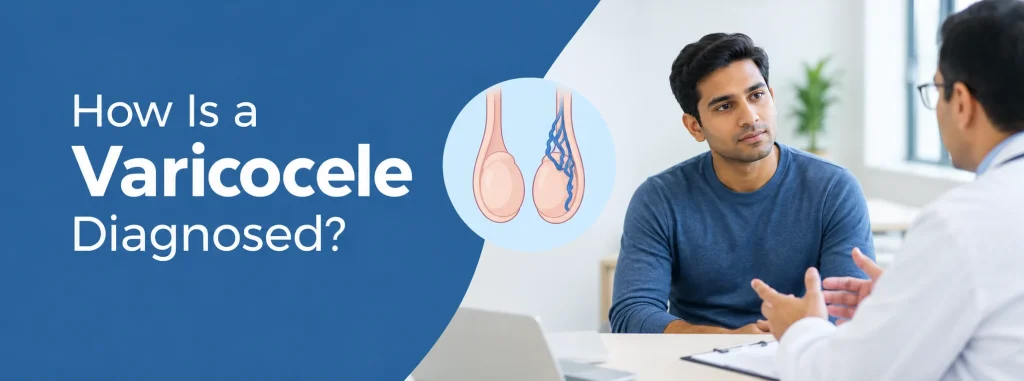
Most men who search this topic carry quiet worries. You may be thinking:
- “Will the exam be embarrassing?”
- “Is this something serious?”
- “Will this affect my chance of having children?”
- “Does my report mean I need an operation?”
These are fair questions. This article answers the first two directly.
For fertility and treatment, we have separate guides, linked below. That way, each answer gets the care it deserves.
How Soon Should You Get Assessed?
Not every change needs the same speed. Use this simple guide.
Urgent: go to an emergency department today
- Sudden, severe pain in a testicle
Act soon: book an appointment within days
- A new lump or swelling you have not had checked
- One testicle looks smaller than before
- A swelling that does not go down when you lie flat
Watchful: keep your regular follow-up
- A small varicocele that your doctor has already checked and that has not changed
If you are unsure which group you fit, choose the faster option. It is always fine to get checked.
What Happens During a Varicocele Assessment
A varicocele assessment is usually short. It has two main parts: a conversation and a physical examination.
Step 1: Your Medical History
Your doctor will start by talking with you. They may ask:
- When you first noticed a change. A long-standing change and a sudden one can mean different things.
- If you feel any discomfort, and when. For example, some men feel a dull ache after standing all day.
- About past surgery or injury. This includes any operation on the groin or scrotum.
- About your general health. This includes your medicines and other conditions.
- If you are planning a family. This is asked only to decide if other tests may help.
Answer as openly as you can. Honest answers help your doctor reach the right conclusion.
What you share stays private between you and your doctor.
Step 2: The Varicocele Examination
The physical exam is the most important step. Your doctor will usually follow this routine:
- A private, warm room. Cold makes the scrotum tighten. This can hide swollen veins.
- Standing first. Veins fill with blood when you stand. This makes a varicocele easier to feel.
- Gentle feeling of the veins. Your doctor gently feels the area above each testicle. Swollen veins can feel like soft, twisted cords.
- Bearing down. You may be asked to take a deep breath, hold it, and push down, as if straining on the toilet. Doctors call this the Valsalva maneuver. It can make a small varicocele easier to feel.
- Checking both sides. Varicoceles are most common on the left. Your doctor still checks both sides.
- Lying down. Your doctor may check again while you lie on your back. A typical varicocele gets smaller or empties when you lie flat.
Step 3: Checking Testicle Size
Your doctor will compare the size of your two testicles. Sometimes a varicocele is linked with one testicle being smaller.
Your doctor may use an orchidometer. This is a string of oval beads, each of a known size. The doctor holds the beads beside the testicle to find the closest match.
It is quick and painless.
For parents of teenage boys: this size check is often a key part of the visit. Doctors may compare growth over time before suggesting any next step.
Feeling Shy? Here Is What to Expect
Many men feel shy before a genital exam. Some delay seeing a doctor for months because of it. You are not alone.
Doctors do these exams often. To them, it is a routine medical check, done with care and respect.
Here is what you can usually expect:
- It is brief. It often takes only a few minutes.
- It should not hurt. You may feel gentle pressure.
- You stay in control. You can ask the doctor to explain each step first. You can ask to pause at any time.
- You can ask for support. You can ask if a chaperone or trusted person may be present.
How to Prepare for Your Visit
- Bring any old reports, scans, or prescriptions.
- Write down your questions before you go.
- Wear loose, comfortable clothes.
Varicocele Grading Explained
After the exam, your doctor may describe your varicocele with a grade. Varicocele grading is based on how easily the veins can be felt or seen.
| Grade | What It Means in Plain Words |
| Subclinical | Cannot be felt or seen in the exam. Found only on an ultrasound. |
| Grade 1 | Small. Felt only when you bear down. |
| Grade 2 | Medium. Felt while you stand normally, without bearing down. |
| Grade 3 | Large. Can be seen through the skin of the scrotum. |
What a Grade Does Not Tell You
A grade describes size. It helps your doctor record findings and track changes over time.
But a grade does not decide whether you need treatment. A higher grade does not automatically mean an operation.
A grade also cannot predict your fertility by itself. If this is your worry, read how varicocele may relate to male fertility.
For questions about care, see our guide on whether treatment is needed.
When Is a Varicocele Ultrasound Used?
Many varicoceles can be found with a careful exam alone. An ultrasound is not needed for everyone.
Your doctor will suggest one only when it is likely to add useful information.
Situations Where an Ultrasound May Help
- The exam is unclear. Body shape, a tight scrotum, or old scars can make veins hard to feel.
- Your doctor wants to confirm the findings. An ultrasound shows the veins directly.
- A more exact size check is needed. Ultrasound measures testicle size more precisely.
- The varicocele may have come back. After past treatment, a scan can check this.
- Something seems unusual. Your doctor may want a closer look.
What a Scrotal Ultrasound for Varicocele Feels Like
The test is usually called a scrotal Doppler ultrasound. “Doppler” shows which way blood is flowing in the veins.
Here is what usually happens:
- You lie on your back. A towel may be used to cover you.
- A cool gel is put on the skin of your scrotum.
- A small handheld device, called a probe, is moved gently over the area.
- You may be asked to bear down or stand, so blood flow can be checked.
The scan uses sound waves, not radiation. It is usually painless. You can go back to normal activities straight after.
Understanding Your Ultrasound Report
Reports are often written in technical English. Here are common terms in plain words:
- Pampiniform plexus: The network of small veins around the testicle. A varicocele is a swelling of these veins.
- Dilated veins: Veins that are wider than usual.
- Venous reflux: Blood flowing backward in the veins. This is a key thing the scan looks for.
- Testicular volume: The measured size of each testicle, often in milliliters (mL).
- Bilateral: Both sides are affected.
About the Numbers on Your Report
Your report may list a number for vein width. It is natural to search what it means.
But cut-off values differ between guidelines and centers. One number cannot confirm or rule out a varicocele.
There is nothing wrong with reading your report. Just bring it to your doctor. They can connect it to what they felt in the exam and what you told them.
How Your Doctor Puts It All Together
A varicocele diagnosis is never based on one finding. Your doctor combines four pieces:
- Your medical history
- The physical exam
- The grade, if a varicocele is found
- Ultrasound results, if a scan was done
This is why two men with similar reports may get different advice.
When Your Doctor May Look Further
Most varicoceles follow a familiar pattern. Sometimes a feature is different. Then your doctor may arrange extra imaging, such as a scan of the abdomen. Examples include:
- A varicocele only on the right side
- A varicocele that appears suddenly in an adult
- Veins that do not empty when you lie down
If this happens, try not to panic. It is a sign of careful practice. It helps make sure nothing is missed.
Other Conditions Your Doctor Will Rule Out
Several other conditions can cause a swelling or lump in the scrotum:
- Hydrocele: Fluid build-up around the testicle
- Inguinal hernia: Tissue pushing down from the groin
- Epididymal cyst: A small fluid-filled sac near the testicle
- Testicular lump: A firm lump inside the testicle, which always needs a prompt check
Never assume a new lump is “just a varicocele.” Please get it checked.
Other Tests You May Hear About
If you are trying for a baby, your doctor may mention a semen analysis (a lab test of a sperm sample) or hormone blood tests.
These tests do not diagnose a varicocele. They answer a separate fertility question. Learn more in our guide on varicocele and male fertility.
After Diagnosis: What Comes Next
A diagnosis is not a treatment decision. These are two separate steps.
Many men with a varicocele never need treatment. Their doctor simply suggests regular check-ups.
To learn what choices may be discussed, see varicocele treatment options. For the bigger picture, read our complete guide to understanding varicocele.
Key Takeaways
- A doctor diagnoses a varicocele mainly through history and examination.
- The exam is usually quick, private, and not painful.
- A grade describes size. It does not decide treatment or predict fertility.
- An ultrasound helps in some cases. Not everyone needs one.
- Your report makes most sense when your doctor reviews it with you.
- Sudden, severe testicle pain is an emergency.
Frequently Asked Questions
Can a varicocele be diagnosed without an ultrasound?
Yes, often it can. Many varicoceles are clearly felt during a careful exam, especially when you stand and bear down. An ultrasound is usually suggested only when the exam is unclear, when exact measurements are needed, or when something looks unusual.
Is the varicocele examination painful?
No, it should not be painful. You may feel gentle pressure for a few minutes. If anything feels uncomfortable, tell your doctor straight away. You can also ask them to explain each step first.
Why does the doctor ask me to stand and bear down?
Standing lets blood fill the scrotal veins. Bearing down raises pressure in your belly for a moment. Both make a small varicocele easier to feel, so it is less likely to be missed.
What does a Grade 2 varicocele mean?
A Grade 2 varicocele can be felt while you stand normally, without bearing down. It usually cannot be seen through the skin. It is a medium size on exam. Your doctor will consider it with your other findings.
Does a higher grade mean I need surgery?
Not necessarily. A grade describes size only. Your doctor also looks at discomfort, testicle size, age, and family plans. Many men with any grade are simply monitored. Learn more about varicocele treatment options.
Can I read my own ultrasound report?
Yes, and knowing common terms can help you feel prepared. But cut-off values vary between centers, and one number rarely tells the full story. Bring your report to your doctor for a proper review.
What is a subclinical varicocele?
It is a varicocele that cannot be felt or seen during an exam. It shows up only on an ultrasound. Your doctor will explain whether it matters for you, based on why the scan was done.
Getting Assessed in Dhaka
If you have noticed a change, or you have a report you want to understand, a calm and private check is a good next step.
Learn more about varicocele assessment in Dhaka, or book a consultation at a time that suits you.
About the Author:
Md. Salauddin Biswas works as a healthcare website SEO and content strategist, assisting doctors and clinics in converting complex medical subjects into clear, trustworthy content.
He holds an MA in Medical Anthropology from the University of Heidelberg, Germany, and an MA in Islamic History & Culture from the University of Dhaka, where he graduated with 1st Class, 1st Position.
He is a former Senior Research Associate at the James P Grant School of Public Health, BRAC University, and a published author in peer-reviewed health research. He has worked in healthcare SEO since 2017 and is based in Dhaka, Bangladesh. Learn more at salauddinbiswas.com/about/.
Medically Reviewed by:
Dr. Nazrul Islam, MBBS, MS (General Surgery)
FCPS (Surgery) · MS (Colorectal Surgery) · FACS (Fellow, American College of Surgeons)
Assistant Professor (Colorectal Surgery), Shaheed Suhrawardy Medical College & Hospital, Dhaka, Bangladesh.
Learn more about Dr. Nazrul Islam.
References:
- Kim DK, Kim DS, Kam SC, Lee HS, Lee WK, Song SH. Recent Guidelines and Perspectives for Varicocele: A Clinical Consensus and Recommendations from the Korean Society for Sexual Medicine and Andrology. World Journal of Men’s Health. 2025.
- Freeman S, Bertolotto M, Richenberg J, Belfield J, et al. Ultrasound evaluation of varicoceles: guidelines and recommendations of the European Society of Urogenital Radiology Scrotal and Penile Imaging Working Group for detection, classification, and grading. European Radiology.
- American Urological Association and American Society for Reproductive Medicine. Report on Varicocele and Infertility.
1
Varicocele Symptoms: What to Notice and When to Seek Care
You may notice a dull pain after a long day, a sensation of heaviness on one side, or new visible veins in your scrotum.
It is normal to feel concerned; many men experience these symptoms. This article explains common varicocele symptoms, when to see a doctor, and when urgent care is needed.
| Medical disclaimer:
This article is for general education only. It is not a diagnosis or personal medical advice. Symptoms alone cannot confirm a varicocele. Always see a qualified doctor about any change in your scrotum or testicles. If you have sudden, severe testicular pain, seek emergency medical care immediately. |
Quick Answer:In many cases, varicoceles cause no symptoms at all. When symptoms do appear, the most common ones are:
You cannot diagnose a varicocele based on symptoms alone, as other conditions can present similarly. A doctor’s examination is necessary. Sudden and severe testicular pain is not a typical symptom of varicocele and could be an emergency. Get medical help right away. |
What Is a Varicocele?
A varicocele is when veins in the scrotum—the skin sac that holds the testicles—become enlarged.
These veins carry blood away from the testicle. When they get bigger, they can look and feel like varicose veins in the legs.
Varicoceles are common and usually develop slowly, most often on the left side.
For more information, please refer to our guide on understanding varicocele.
Many Varicoceles Cause No Symptoms
You can have a varicocele and not notice it at all. Many men only find out by accident, such as during:
- A routine check-up
- A visit for another health concern
- A self-check or while bathing
It’s common to have no symptoms. This doesn’t mean anything has been missed or that you need to do anything.
Symptoms vary from person to person. Some men barely notice them, while others feel more discomfort. Both are normal.
Common Varicocele Signs and Symptoms
Varicocele signs are usually mild and tend to develop slowly, not suddenly.
People usually notice the following signs:
A Dull Ache or Varicocele Pain:
Varicocele pain is usually dull rather than sharp. People often describe it as:
• Aching or dragging
• Mild discomfort that comes and goes
• A feeling of fullness in the scrotum
The pain often improves when you lie flat on your back. This position helps blood drain from the veins, which lowers the pressure.
This is a common sign of varicocele, but it’s not enough to confirm you have one.
Scrotal Heaviness:
A common symptom is a heavy feeling in the scrotum. Sometimes one side feels heavier, fuller, or like it’s being pulled down.
This feeling is usually stronger on one side, most often the left. Many men notice it at the end of the day, and it often goes away after rest or sleep.
Visible Scrotal Veins:
A large varicocele can make the veins in the scrotum visible. You might see bluish, twisted veins through the skin.
You might also feel soft, rope-like cords above the testicle. These veins usually:
• Stand out more when you stand up
• Look less obvious when you lie down
• Are easier to notice in warm weather or after a hot bath
Small varicoceles often can’t be seen or felt at home. They’re usually found by a doctor during an exam.
A Difference in Testicle Size:
One testicle may look or feel smaller than the other. This change is usually slow and slight.
If you notice this, see a doctor. Don’t try to judge the cause yourself, since size differences can have several reasons.
When Symptoms Tend to Show Up
Varicocele symptoms often follow a pattern. You might notice them more:
• If you have stood for a long time, jobs that keep you on your feet can make the ache more noticeable.
• By the end of the day, discomfort tends to increase as the day progresses.
• While carrying out the action or afterwards. Doing some exercise, lifting heavy objects, or straining can temporarily worsen the heaviness.
• When it’s hot; whether due to hot weather or from taking a hot bath the veins can become more noticeable.
Varicoceles usually show up during the teenage years or early adulthood, but they can happen at any age.
What Varicocele Discomfort Usually Is Not
Varicocele discomfort is usually mild and develops slowly. It’s not typically:
• Sudden, severe, or stabbing pain
• Pain that comes with fever, nausea, or vomiting
• Swelling that grows quickly
If you have any of these symptoms, something else could be going on. For more details, see the urgent care section below.
Not Every Scrotal Change Is a Varicocele
This is one of the main points of the article.
Pain, swelling, or a lump in the scrotum can have many causes. Some are harmless, while others need quick treatment.
Conditions that can cause similar symptoms include:
• Hydrocele: fluid that builds up around the testicle
• Epididymitis or orchitis: swelling or infection of the tube behind the testicle, or of the testicle itself
• Inguinal hernia: tissue from the belly pushing into the groin or scrotum
• Cyst: a small, fluid-filled lump, often near the top of the testicle
• Testicular torsion: the testicle twists and cuts off its own blood supply
• Testicular tumor: less common, but important to rule out
Don’t assume a lump is a varicocele, even if a friend had something similar. Only an exam can tell for sure.
Most changes in the scrotum aren’t serious, but only a doctor’s exam can confirm that.
⚠️When to Seek Urgent Medical Care
Get emergency help right away if you have:
• There may be a sudden and intense pain in one of the testicles, which can be a sign of testicular torsion and requires treatment within hours in order to save the testicle.
• Testicular pain with nausea or vomiting
• A scrotum that swells quickly, or turns red, hot, or tender
• Scrotal pain or swelling with a fever, which may point to an infection
• Pain or swelling after an injury to the groin
You shouldn’t wait to find out whether it goes away or spend time searching online. Go to the nearest emergency department. cy, and the symptoms indicate other issues.
When to Book a Doctor’s Appointment
Some symptoms aren’t emergencies, but it’s still a good idea to see a doctor soon.
Book an appointment if you:
• Notice a new lump, swelling, or change in your scrotum, even if it doesn’t hurt
• Have an ache or heaviness that lasts more than a few days or keeps coming back
• Can see or feel enlarged, twisted veins
• Notice one testicle looks or feels smaller, especially if it’s new
• Find that the veins don’t get smaller when you lie down
• Notice veins that appear suddenly, appear only on the right side, or first appear later in adult life
• Feel discomfort that gets in the way of work, exercise, or daily life
• Are worried about having children
To rule out any other possible causes, it’s best to have these symptoms checked soon rather than wait. You should contact the clinic.
How to Prepare for Your Visit
A few notes can help your doctor understand your situation. Before your appointment, make a list of:
• When you first noticed the change
• Which side does it affect
• Whether it has grown or changed
• What makes it better or worse, such as standing, lying down, heat, or exercise
• Any other symptoms, like fever or pain when passing urine
• Any questions or worries you have
Doctors check this area every day, so there’s no need to feel embarrassed. Clear details help them give you clear answers.
What Comes Next
A doctor will talk with you and do an exam to find out if you have a varicocele. To learn more about the diagnosis process, see the section on how a varicocele is diagnosed.
If you’re worried about fertility, check the section on varicocele and male fertility. The effect varies from man to man and requires a personal evaluation.
Key Takeaways
✅ Many varicoceles cause no symptoms. Some are found by chance during a routine check.
✅ Common signs are a dull ache, scrotal heaviness, and visible or twisted veins.
✅ Symptoms often get worse after standing, at the end of the day, or with effort, and ease when you lie down.
✅ Symptoms can’t confirm a varicocele. Other conditions can feel the same.
✅ A new lump always needs a doctor’s check. Don’t assume it’s a varicocele.
✅ Sudden, severe testicular pain is an emergency. Get urgent care right away.
Frequently Asked Questions
Does a varicocele always cause pain?
No. Many men have no symptoms at all. When pain happens, it is usually a dull, dragging ache, not a sharp pain.
Is varicocele pain constant?
Usually not. It tends to come and go. It often gets worse with standing or activity and eases with rest.
Why does the ache get better when I lie down?
Lying flat helps blood drain from the widened veins. That lowers the pressure, so the ache often eases.
Can I tell on my own if I have a varicocele?
You can notice changes, but you can’t confirm a varicocele yourself. Other conditions can cause the same symptoms. A doctor needs to examine you.
Which side does a varicocele usually affect?
It most often affects the left side. Tell your doctor if you notice changes on the right side or on both sides.
Is a varicocele dangerous?
A varicocele is usually not an emergency. But sudden, severe testicular pain always needs urgent care, because it may be a different, time-sensitive problem.
Talk to a Doctor About Your Symptoms
You don’t have to figure this out alone. If you’ve noticed any of the signs above, or you simply want peace of mind, an examination is the safest next step.
Your doctor will listen, examine you, and explain what is happening in your case.
If you’re in Dhaka, you can learn more about varicocele care in Dhaka with Dr. Nazrul Islam [verify clinician services, credentials, and clinic location before publishing], or contact the clinic to book a consultation.
References
- EAU Guidelines on Sexual and Reproductive Health (2025 PDF) – https://d56bochluxqnz.cloudfront.net/documents/EAU-Guidelines-on-Sexual-and-Reproductive-Health-2025.pdf
- AUA/ASRM Guideline: Diagnosis and Treatment of Infertility in Men, Part I – https://www.auajournals.org/doi/pdf/10.1097/JU.0000000000001521
- World Journal of Men’s Health review: Recent Guidelines and Perspectives for Varicocele – https://www.wjmh.org/pdf/10.5534/wjmh.240290
About the Author:
Md. Salauddin Biswas works as a healthcare website SEO and content strategist, assisting doctors and clinics in converting complex medical subjects into clear, trustworthy content.
He holds an MA in Medical Anthropology from the University of Heidelberg, Germany, and an MA in Islamic History & Culture from the University of Dhaka, where he graduated with 1st Class, 1st Position.
He is a former Senior Research Associate at the James P Grant School of Public Health, BRAC University, and a published author in peer-reviewed health research. He has worked in healthcare SEO since 2017 and is based in Dhaka, Bangladesh. Learn more at salauddinbiswas.com/about/.
Medically Reviewed by:
Dr. Nazrul Islam, MBBS, MS (General Surgery)
FCPS (Surgery) · MS (Colorectal Surgery) · FACS (Fellow, American College of Surgeons)
Assistant Professor (Colorectal Surgery), Shaheed Suhrawardy Medical College & Hospital, Dhaka, Bangladesh.
Learn more about Dr. Nazrul Islam.
Related Topics:
Varicocele Symptoms
Varicocele Diagnosis
Varicocele and Fertility
Varicocele Treatment Options
Varicocele Surgery
Varicocele Surgery vs Embolization
Last Updated: September 28, 2026
Frequently Asked Questions
Here are honest answers to common questions people ask before seeing a colorectal surgeon in Dhaka.
These answers are general. Your own situation may be different, and that is exactly why a proper consultation matters.
What does a colorectal surgeon treat?
A colorectal surgeon diagnoses and treats diseases of the colon, rectum and anus. This includes পাইলস (piles), এনাল ফিসার (fissure), ফিস্টুলা (fistula), abscess, rectal prolapse, pilonidal sinus, inflammatory bowel disease and colon or rectal cancer. Many conditions can be treated with medicine, diet changes or minor procedures. Surgery is recommended only when it is truly needed.
How do I know if my bleeding is from piles or something more serious like cancer?
You cannot tell the cause of rectal bleeding by looking at it alone. Piles and fissure are the most common causes, and both are treatable. However, polyps and colorectal cancer can also cause bleeding. Warning signs include blood mixed with stool, weight loss, anemia or a lasting change in bowel habits. Any repeated or unexplained bleeding should be checked by a colorectal surgeon. An early check is always safer than waiting.
Do piles always need surgery? Can they be treated without an operation?
No, most piles do not need surgery. Early-stage piles often improve with more fiber, more water, less straining and medicine. Larger or complicated piles may need a minor procedure or an operation. The right treatment depends on the stage of your piles and your overall health, and this can only be decided after an examination. Delaying treatment can allow the condition to get worse
How long does recovery take after piles, fissure or hernia surgery?
Recovery depends on the type of operation and your general health. After piles or fissure surgery, many patients go home within a day and return to light activities within a few days, while full healing may take a few weeks. Laparoscopic hernia repair usually allows a faster return to normal activity than open surgery. Your surgeon will give you a recovery plan based on your procedure.
Is laparoscopic surgery better than open surgery for hernia and gallstones?
For many patients, laparoscopic (keyhole) surgery means smaller cuts, less pain, a shorter hospital stay and a faster recovery. It is now widely used for gallstones and many hernias. However, it is not right for everyone. The best method depends on the size and complexity of the problem, your health and your surgeon’s assessment. Dr. Nazrul performs both methods and chooses the one that is safer for you.
I feel embarrassed about my anal problem. Is it safe to talk to a doctor about it?
Yes, it is completely safe, and your feelings are very common. Colorectal surgeons see these conditions every day and treat every patient with respect and privacy. Many people in Bangladesh delay care for months or years because of shame. That delay can turn a simple, treatable problem into a complicated one. Man or woman, young or old, your dignity is always respected during examination and treatment.
When should I see a colorectal surgeon instead of a general doctor?
You should see a colorectal surgeon if you have repeated bleeding from the anus, severe pain during or after stool, a lump near the anus, pus or discharge, long-term constipation or diarrhea, or unexplained weight loss with bowel changes. A colorectal surgeon has extra training focused on the colon, rectum and anus. This helps with an accurate diagnosis and the right treatment from the start.
How do I choose the best colorectal surgeon in Dhaka?
The best colorectal surgeon in Dhaka for you is one with proper qualifications, long experience and a clear, honest way of explaining your options. Check for specialist training in colorectal surgery, BMDC registration and experience with both open and laparoscopic methods. It also matters that the surgeon listens to you and does not rush you into surgery. Dr. Nazrul holds FCPS, MS (Colorectal Surgery) and FACS (USA), and his BMDC registration number is A-42965.
Is colorectal surgery in Dhaka available with international-standard training?
Yes. Dr. Muhammad Nazrul Islam trained in both Bangladesh and the USA. He is a Fellow of the American College of Surgeons (FACS) and also holds FCPS (Surgery) and MS (Colorectal Surgery). This combination of local and international training allows him to follow evidence-based surgical practice for patients in Dhaka.
Can I book a consultation if I do not know the name of my condition?
Yes, absolutely. You do not need to know the medical term. Just describe your symptoms in your own words, in Bangla or English. Dr. Nazrul will examine you and explain what is causing the problem and how it can be treated.
Ready to Talk About Your Problem?
The easiest way to book an appointment with Dr. Nazrul is to call or send a WhatsApp message to his assistant at +8801976-842234.
When you contact us, please share your name, age, main problem and how long you have had it. This helps us plan your visit.
Phone / WhatsApp
+8801976-842234
Assistant Professor ( Colorectal Surgery ),
Shaheed Suhrawardy Medical College and Hospital.
Government Registration Number: BMDC – A-42965
This form is for appointment requests and general questions only. It is not suitable for emergency medical advice.