Last Updated: June, 2026
Introduction to Piles Treatment Options
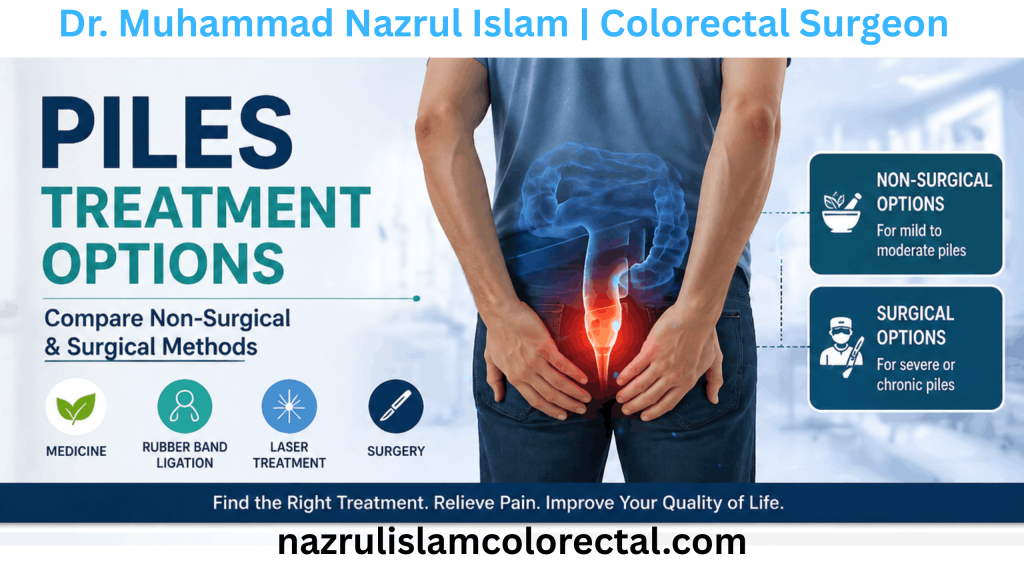
Piles can be treated in many ways. But the right treatment is not the same for every person. It depends on your symptoms, the type of piles you have, and — most importantly — the grade.
Some people recover with simple diet and lifestyle changes. Others need a clinic procedure. Some need laser treatment or surgery. Understanding which option fits your situation is what this article is about.
This is not a general overview of piles. For the full educational guide covering symptoms, causes, grades, and all treatment types from the beginning, read the main guide first:
Read: Complete Guide to Piles Treatment in Bangladesh →
Quick Decision Guide: Which Treatment May You Need?
- Mild bleeding, no prolapse: start with diet, water, medicine, sitz bath
- Bleeding with pile coming out but returning on its own: medicine or rubber band ligation
- Pile must be pushed back manually: laser or surgery consultation needed
- Pile stays outside permanently: surgery is usually required
- Sudden painful lump near anus: urgent doctor visit — possible thrombosis
How to Match Your Situation to the Right Treatment
Before comparing treatment methods, the most useful question is: what is your current situation? The table below helps you match your symptoms to the most likely treatment path.
| Your Situation | Recommended First Step | Why |
|---|---|---|
| Mild bleeding, no lump coming out | Diet, water, medicine, sitz bath | Grade 1 — no procedure needed yet |
| Bleeding + pile comes out but returns on its own | Rubber band ligation or medicine | Grade 2 — minimally invasive option available |
| Pile must be pushed back manually after passing stool | Laser or surgery consultation | Grade 3 — needs specialist decision |
| Pile stays outside permanently, cannot be pushed back | Surgery | Grade 4 — procedure alone not enough |
| Sudden painful hard lump near anus | Urgent doctor visit | Possible thrombosed external pile |
Understanding your grade is the most important step before choosing any treatment. The 4 grades of internal piles — and exactly which treatment suits each grade — are explained in full detail in the main guide.Read: Piles Treatment in Bangladesh — Full Grade Guide →
Non-Surgical Piles Treatment Options
Non-surgical treatments work best for early-stage piles. They can also support recovery after a procedure. Here is what each option involves in practice.
1. Diet, Water, and Bowel Habit Changes
This is always the first step — regardless of grade. The goal is to make stool softer so you stop straining. Straining is the single biggest driver of worsening piles.
Practical changes that make a real difference:
- Add one high-fibre food to every meal — guava, papaya, jackfruit seeds, lentils, oats, or leafy vegetables
- Drink water consistently throughout the day — not just when thirsty
- Go to the toilet when you feel the urge — do not delay
- Keep toilet visits under 5 minutes — put the phone down
- Walk for at least 20 minutes daily to stimulate bowel movement
These changes alone can resolve Grade 1 piles and significantly reduce symptoms in Grade 2.
2. Medicines for Piles
Medicines can reduce pain, swelling, itching, and bleeding in the short term. They may include pain relief tablets, topical creams or ointments, stool softeners, and fibre supplements.
The key limitation: medicines manage symptoms but do not remove the pile tissue. If bleeding or prolapse keeps returning, a procedure or surgery may be needed.
Read: Best Piles Medicine in Bangladesh — Complete Guide →
3. Sitz Bath
A sitz bath involves sitting in a basin of warm — not hot — water for about 10 to 15 minutes. It works by relaxing the anal muscles, improving blood flow, and reducing swelling and irritation around the anus.
It is most effective when done immediately after passing stool. Doing it 2 to 3 times daily during a flare-up gives the best relief. It is safe, low-cost, and can be done at home.
4. Rubber Band Ligation
Rubber band ligation is performed in the clinic and does not require general anaesthesia in most cases. The doctor uses a small instrument to place a tight elastic band at the base of the internal pile, cutting off its blood supply.
Over the following 3 to 7 days, the pile tissue dries out and separates naturally. Most patients feel only mild pressure during the procedure and return to normal activity within 1 to 2 days.
It is a suitable option for selected Grade 2 and some Grade 3 internal piles. It is not appropriate for external piles, thrombosed piles, or patients with certain medical conditions. Your doctor will confirm suitability after examination.
5. Other Clinic-Based Procedures
Depending on the doctor’s assessment and available facilities, other clinic-based options may be used to reduce bleeding or shrink pile tissue in selected patients. The method chosen will depend on your specific condition.
Surgical Piles Treatment Options
When non-surgical methods are not enough — or when piles are too large, too painful, or too advanced — surgical treatment becomes the right path.
1. Laser Piles Treatment
Laser treatment uses a precisely controlled beam of energy to shrink and seal the swollen pile tissue. Because the laser targets only the affected area, surrounding healthy tissue is largely undisturbed.
Patients who are suitable for laser treatment often report less post-procedure discomfort compared to traditional surgery. The wound is smaller, which reduces infection risk and speeds up the return to sitting comfortably. Most patients go home the same day or the following morning.
However, not every patient qualifies. The doctor decides after examining the grade, size, and position of the pile. Severe or Grade 4 piles may still need standard surgery for complete relief.
Read: Laser Piles Treatment in Dhaka — Procedure, Cost & Recovery →
2. Traditional Surgery (Hemorrhoidectomy)
Traditional hemorrhoidectomy surgically removes the pile tissue. It remains the most effective option for Grade 4 piles, large prolapsed piles, or cases where other treatments have not worked.
Recovery takes longer than laser treatment — typically 2 to 4 weeks depending on the extent of surgery. But for the right patient, it provides thorough and lasting relief that other methods cannot always match.
3. Stapled Hemorrhoidopexy
Stapled hemorrhoidopexy is a specialised procedure for selected cases of internal prolapsed piles. Rather than removing the pile, it repositions the prolapsed tissue back inside the anal canal and reduces its blood supply using a circular stapling device.
It may result in less post-operative pain than traditional surgery in suitable cases. But it is not appropriate for external piles or all types of prolapse. Suitability must be confirmed by a specialist.
Comparing Your Options: What Matters Most When Deciding
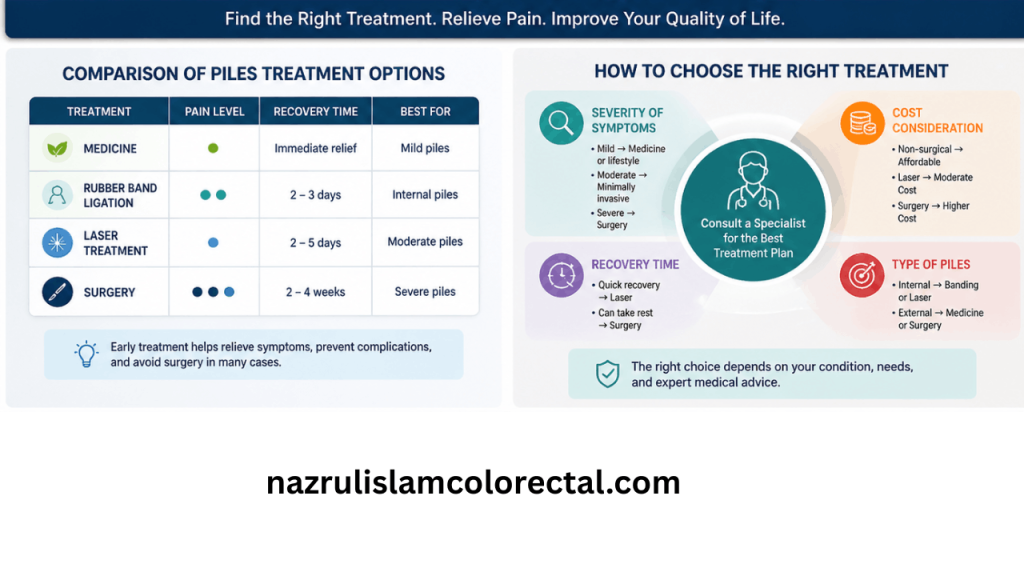
Beyond the grade of piles, four practical factors shape the final treatment decision.
1. How Quickly Do You Need Relief?
If your symptoms are mild and not worsening, starting with diet and medicine is reasonable. If you have repeated bleeding, a prolapsed pile, or significant pain, waiting is not advisable. A specialist consultation will clarify urgency.
2. How Much Recovery Time Can You Take?
Rubber band ligation typically needs 1 to 2 days of rest. Laser treatment often allows return to light activity within 3 to 5 days. Traditional surgery may need 2 to 4 weeks before full normal activity resumes. Your work and family situation matters when planning treatment.
3. Is the Procedure Suitable for Your Grade?
Not every procedure works for every grade. Laser treatment is not a universal solution. Rubber band ligation does not work for external piles. Surgery is not always needed for Grade 2. This is why examination comes before any treatment decision.
4. Cost and Follow-Up
Treatment cost in Bangladesh varies based on the procedure type, anaesthesia, hospital, investigations, medicine, and follow-up visits. A proper consultation gives you an accurate picture — not a general estimate.
Read: Best Piles Treatment in Dhaka — Specialist Care →
Why Treating Piles Early Makes a Difference
Grade 1 piles treated early rarely need surgery. Grade 4 piles that were once Grade 2 — left untreated for years — almost always do. The gap between those two outcomes is often just a matter of acting sooner.
Early treatment can:
- stop bleeding before it causes anaemia
- prevent a Grade 2 pile from becoming Grade 3 or 4
- avoid the need for general anaesthesia and hospital admission
- reduce total treatment cost significantly
- allow faster return to normal daily life
Delaying treatment — especially when symptoms keep returning — rarely leads to spontaneous improvement. It usually leads to more complex treatment later.
Not Sure Which Treatment You Need?
A proper examination identifies your grade, rules out other causes of bleeding, and gives you a clear treatment plan — not a guess.
Early diagnosis makes treatment simpler, faster, and less costly.
Frequently Asked Questions
What is the best treatment for piles?
There is no single best treatment for everyone. The right option depends on your grade and symptoms. A specialist examination is the only reliable way to identify which treatment fits your specific case.
Can piles be treated without surgery?
Yes — many early-stage piles respond well to diet changes, medicine, stool softeners, sitz bath, and selected clinic procedures. Surgery is typically reserved for Grade 3 and Grade 4 cases that do not respond to other methods.
Is laser better than surgery?
Laser treatment offers less post-procedure discomfort and faster recovery for suitable Grade 2 and Grade 3 cases. But it is not always the better choice for every patient. Grade 4 or complex piles may still need standard surgery for complete and lasting relief.
How long does piles treatment take?
Recovery varies by method. Medicine may show improvement within days. Rubber band ligation typically needs 1 to 3 days. Laser treatment recovery is often faster than surgery. Traditional surgery may need 2 to 4 weeks depending on the case.
Which treatment gives long-term relief?
Any treatment can give long-term relief when matched correctly to the grade and symptoms. But piles can return if the root causes — constipation, straining, and long toilet sitting — are not corrected after treatment.
When should I see a doctor?
See a doctor if you have repeated rectal bleeding, severe pain, a lump near the anus, fever, dizziness, weakness, or symptoms that do not improve. Not all rectal bleeding is caused by piles — it needs proper diagnosis.
What Should You Do Next?
If you are unsure which treatment is right for you, a specialist consultation is the clearest next step. A proper examination will confirm your grade, rule out other conditions, and give you a treatment plan based on your actual situation — not a general estimate.
Read More
Cleveland Clinic: Hemorrhoids Guide ↗
NHS: Piles Haemorrhoids Guide ↗
Written by: Md. Salauddin Biswas
Md. Salauddin Biswas is an SEO and E-E-A-T specialist with a background in Medical Anthropology and public health research. He completed his MA in Medical Anthropology from the University of Heidelberg, Germany, and has worked in health research and program management with institutions like James P Grant School of Public Health.
He has experience in qualitative health research, health systems analysis, and medical content development, with publications in peer-reviewed journals related to health and social care.
Medically Reviewed by: Dr. Muhammad Nazrul Islam
Dr. Muhammad Nazrul Islam, FCPS, MS Colorectal Surgery, FACS, is an Assistant Professor of Colorectal Surgery at Shaheed Suhrawardy Medical College & Hospital, Dhaka.
He is an experienced colorectal surgeon specializing in the diagnosis and treatment of piles, fissure, fistula, and other colorectal conditions, including laser piles treatment and minimally invasive surgery for selected patients.