
You may notice a dull pain after a long day, a sensation of heaviness on one side, or new visible veins in your scrotum.
It is normal to feel concerned; many men experience these symptoms. This article explains common varicocele symptoms, when to see a doctor, and when urgent care is needed.
| Medical disclaimer:
This article is for general education only. It is not a diagnosis or personal medical advice. Symptoms alone cannot confirm a varicocele. Always see a qualified doctor about any change in your scrotum or testicles. If you have sudden, severe testicular pain, seek emergency medical care immediately. |
Quick Answer:In many cases, varicoceles cause no symptoms at all. When symptoms do appear, the most common ones are:
You cannot diagnose a varicocele based on symptoms alone, as other conditions can present similarly. A doctor’s examination is necessary. Sudden and severe testicular pain is not a typical symptom of varicocele and could be an emergency. Get medical help right away. |
What Is a Varicocele?
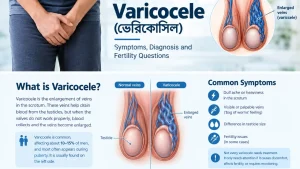
A varicocele is when veins in the scrotum—the skin sac that holds the testicles—become enlarged.
These veins carry blood away from the testicle. When they get bigger, they can look and feel like varicose veins in the legs.
Varicoceles are common and usually develop slowly, most often on the left side.
For more information, please refer to our guide on understanding varicocele.
Many Varicoceles Cause No Symptoms
You can have a varicocele and not notice it at all. Many men only find out by accident, such as during:
- A routine check-up
- A visit for another health concern
- A self-check or while bathing
It’s common to have no symptoms. This doesn’t mean anything has been missed or that you need to do anything.
Symptoms vary from person to person. Some men barely notice them, while others feel more discomfort. Both are normal.
Common Varicocele Signs and Symptoms
Varicocele signs are usually mild and tend to develop slowly, not suddenly.
People usually notice the following signs:
A Dull Ache or Varicocele Pain:
Varicocele pain is usually dull rather than sharp. People often describe it as:
• Aching or dragging
• Mild discomfort that comes and goes
• A feeling of fullness in the scrotum
The pain often improves when you lie flat on your back. This position helps blood drain from the veins, which lowers the pressure.
This is a common sign of varicocele, but it’s not enough to confirm you have one.
Scrotal Heaviness:
A common symptom is a heavy feeling in the scrotum. Sometimes one side feels heavier, fuller, or like it’s being pulled down.
This feeling is usually stronger on one side, most often the left. Many men notice it at the end of the day, and it often goes away after rest or sleep.
Visible Scrotal Veins:
A large varicocele can make the veins in the scrotum visible. You might see bluish, twisted veins through the skin.
You might also feel soft, rope-like cords above the testicle. These veins usually:
• Stand out more when you stand up
• Look less obvious when you lie down
• Are easier to notice in warm weather or after a hot bath
Small varicoceles often can’t be seen or felt at home. They’re usually found by a doctor during an exam.
A Difference in Testicle Size:
One testicle may look or feel smaller than the other. This change is usually slow and slight.
If you notice this, see a doctor. Don’t try to judge the cause yourself, since size differences can have several reasons.
When Symptoms Tend to Show Up
Varicocele symptoms often follow a pattern. You might notice them more:
• If you have stood for a long time, jobs that keep you on your feet can make the ache more noticeable.
• By the end of the day, discomfort tends to increase as the day progresses.
• While carrying out the action or afterwards. Doing some exercise, lifting heavy objects, or straining can temporarily worsen the heaviness.
• When it’s hot; whether due to hot weather or from taking a hot bath the veins can become more noticeable.
Varicoceles usually show up during the teenage years or early adulthood, but they can happen at any age.
What Varicocele Discomfort Usually Is Not
Varicocele discomfort is usually mild and develops slowly. It’s not typically:
• Sudden, severe, or stabbing pain
• Pain that comes with fever, nausea, or vomiting
• Swelling that grows quickly
If you have any of these symptoms, something else could be going on. For more details, see the urgent care section below.
Not Every Scrotal Change Is a Varicocele
This is one of the main points of the article.
Pain, swelling, or a lump in the scrotum can have many causes. Some are harmless, while others need quick treatment.
Conditions that can cause similar symptoms include:
• Hydrocele: fluid that builds up around the testicle
• Epididymitis or orchitis: swelling or infection of the tube behind the testicle, or of the testicle itself
• Inguinal hernia: tissue from the belly pushing into the groin or scrotum
• Cyst: a small, fluid-filled lump, often near the top of the testicle
• Testicular torsion: the testicle twists and cuts off its own blood supply
• Testicular tumor: less common, but important to rule out
Don’t assume a lump is a varicocele, even if a friend had something similar. Only an exam can tell for sure.
Most changes in the scrotum aren’t serious, but only a doctor’s exam can confirm that.
⚠️When to Seek Urgent Medical Care
Get emergency help right away if you have:
• There may be a sudden and intense pain in one of the testicles, which can be a sign of testicular torsion and requires treatment within hours in order to save the testicle.
• Testicular pain with nausea or vomiting
• A scrotum that swells quickly, or turns red, hot, or tender
• Scrotal pain or swelling with a fever, which may point to an infection
• Pain or swelling after an injury to the groin
You shouldn’t wait to find out whether it goes away or spend time searching online. Go to the nearest emergency department. cy, and the symptoms indicate other issues.
When to Book a Doctor’s Appointment
Some symptoms aren’t emergencies, but it’s still a good idea to see a doctor soon.
Book an appointment if you:
• Notice a new lump, swelling, or change in your scrotum, even if it doesn’t hurt
• Have an ache or heaviness that lasts more than a few days or keeps coming back
• Can see or feel enlarged, twisted veins
• Notice one testicle looks or feels smaller, especially if it’s new
• Find that the veins don’t get smaller when you lie down
• Notice veins that appear suddenly, appear only on the right side, or first appear later in adult life
• Feel discomfort that gets in the way of work, exercise, or daily life
• Are worried about having children
To rule out any other possible causes, it’s best to have these symptoms checked soon rather than wait. You should contact the clinic.
How to Prepare for Your Visit
A few notes can help your doctor understand your situation. Before your appointment, make a list of:
• When you first noticed the change
• Which side does it affect
• Whether it has grown or changed
• What makes it better or worse, such as standing, lying down, heat, or exercise
• Any other symptoms, like fever or pain when passing urine
• Any questions or worries you have
Doctors check this area every day, so there’s no need to feel embarrassed. Clear details help them give you clear answers.
What Comes Next
A doctor will talk with you and do an exam to find out if you have a varicocele. To learn more about the diagnosis process, see the section on how a varicocele is diagnosed.
If you’re worried about fertility, check the section on varicocele and male fertility. The effect varies from man to man and requires a personal evaluation.
Key Takeaways
✅ Many varicoceles cause no symptoms. Some are found by chance during a routine check.
✅ Common signs are a dull ache, scrotal heaviness, and visible or twisted veins.
✅ Symptoms often get worse after standing, at the end of the day, or with effort, and ease when you lie down.
✅ Symptoms can’t confirm a varicocele. Other conditions can feel the same.
✅ A new lump always needs a doctor’s check. Don’t assume it’s a varicocele.
✅ Sudden, severe testicular pain is an emergency. Get urgent care right away.
Frequently Asked Questions
Does a varicocele always cause pain?
No. Many men have no symptoms at all. When pain happens, it is usually a dull, dragging ache, not a sharp pain.
Is varicocele pain constant?
Usually not. It tends to come and go. It often gets worse with standing or activity and eases with rest.
Why does the ache get better when I lie down?
Lying flat helps blood drain from the widened veins. That lowers the pressure, so the ache often eases.
Can I tell on my own if I have a varicocele?
You can notice changes, but you can’t confirm a varicocele yourself. Other conditions can cause the same symptoms. A doctor needs to examine you.
Which side does a varicocele usually affect?
It most often affects the left side. Tell your doctor if you notice changes on the right side or on both sides.
Is a varicocele dangerous?
A varicocele is usually not an emergency. But sudden, severe testicular pain always needs urgent care, because it may be a different, time-sensitive problem.
Talk to a Doctor About Your Symptoms
You don’t have to figure this out alone. If you’ve noticed any of the signs above, or you simply want peace of mind, an examination is the safest next step.
Your doctor will listen, examine you, and explain what is happening in your case.
If you’re in Dhaka, you can learn more about varicocele care in Dhaka with Dr. Nazrul Islam [verify clinician services, credentials, and clinic location before publishing], or contact the clinic to book a consultation.
References
- EAU Guidelines on Sexual and Reproductive Health (2025 PDF) – https://d56bochluxqnz.cloudfront.net/documents/EAU-Guidelines-on-Sexual-and-Reproductive-Health-2025.pdf
- AUA/ASRM Guideline: Diagnosis and Treatment of Infertility in Men, Part I – https://www.auajournals.org/doi/pdf/10.1097/JU.0000000000001521
- World Journal of Men’s Health review: Recent Guidelines and Perspectives for Varicocele – https://www.wjmh.org/pdf/10.5534/wjmh.240290
About the Author:
Md. Salauddin Biswas works as a healthcare website SEO and content strategist, assisting doctors and clinics in converting complex medical subjects into clear, trustworthy content.
He holds an MA in Medical Anthropology from the University of Heidelberg, Germany, and an MA in Islamic History & Culture from the University of Dhaka, where he graduated with 1st Class, 1st Position.
He is a former Senior Research Associate at the James P Grant School of Public Health, BRAC University, and a published author in peer-reviewed health research. He has worked in healthcare SEO since 2017 and is based in Dhaka, Bangladesh. Learn more at salauddinbiswas.com/about/.
Medically Reviewed by:
Dr. Nazrul Islam, MBBS, MS (General Surgery)
FCPS (Surgery) · MS (Colorectal Surgery) · FACS (Fellow, American College of Surgeons)
Assistant Professor (Colorectal Surgery), Shaheed Suhrawardy Medical College & Hospital, Dhaka, Bangladesh.
Learn more about Dr. Nazrul Islam.
Related Topics:
Varicocele Symptoms
Varicocele Diagnosis
Varicocele and Fertility
Varicocele Treatment Options
Varicocele Surgery
Varicocele Surgery vs Embolization
Last Updated: September 28, 2026




1 comment