
Quick Answer:
A varicocele is made up of enlarged veins in the scrotum, similar to varicose veins in the legs. Many men have no symptoms, but if symptoms do appear, they might notice a dull ache, visible veins, or a feeling of heaviness. Not every varicocele needs treatment. Before deciding what to do, it helps to understand what a varicocele is, what symptoms to look for, how it is diagnosed, and whether it could affect fertility.
Medical Disclaimer:This page provides general educational information only and does not replace a medical examination. A varicocele can only be diagnosed by a qualified doctor through physical examination and, when needed, an ultrasound. Symptoms described here may also be caused by other conditions. Any new scrotal swelling, discomfort, or sudden severe pain should be assessed in person by a specialist. Do not use this page to diagnose yourself or decide on treatment without professional guidance.
|
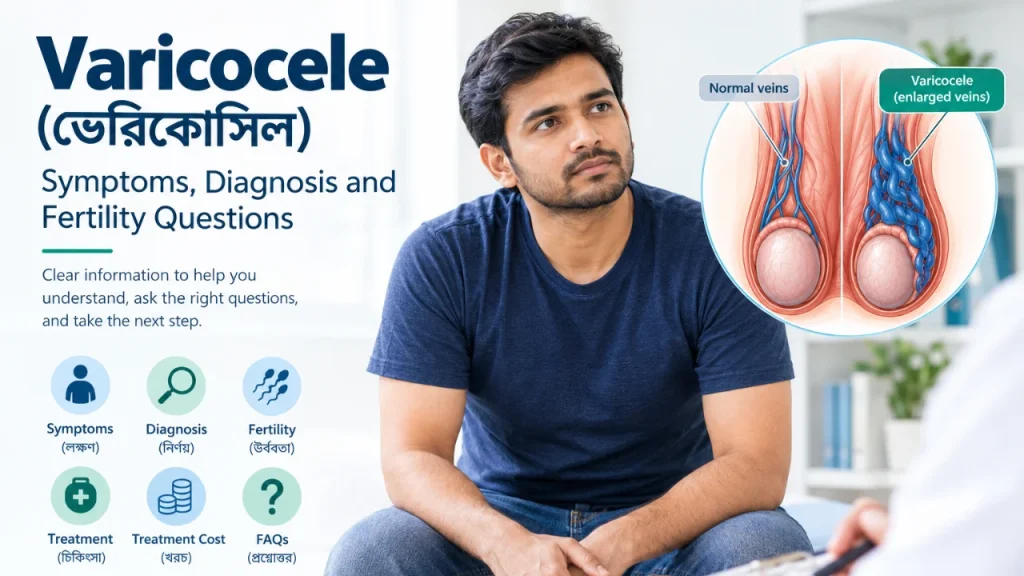
You might have noticed a change, like a dull pain in your scrotum or a new feeling of heaviness. Maybe you saw enlarged veins while in the shower, or your doctor mentioned ‘varicocele’ during a checkup or fertility test.
It’s normal to feel concerned. The scrotum is a sensitive area, so any change can be worrying. You might wonder if this is serious, if it will get worse, or if it could affect your ability to have children.
This page is here to help you understand what a varicocele is, what symptoms you might have, how doctors find it, and whether it could affect your fertility. You don’t have to decide anything right now. The goal is to give you clear, honest information so you know which questions to ask and which steps might be right for you.
What Is a Varicocele?
A varicocele consists of the enlargement of the veins in the scrotum, which form part of the pampiniform plexus, a network responsible for draining blood from the testicles.
Varicoceles are similar to varicose veins in the legs because the same process happens. If the valves in the veins do not function properly, blood collects rather than flowing smoothly back to the heart. This causes the veins to stretch and get bigger over time.
Varicoceles are common. Research shows they affect about 10 to 15 out of every 100 men. They usually appear during puberty, when blood flow to the scrotum increases as the body grows.
Most varicoceles are found on the left side. This is because the vein from the left testicle drains into a larger vein at a steeper angle, making it harder for blood to flow upward. Right-sided or bilateral varicoceles are less common.
It’s important to remember that having a varicocele does not mean you have a problem. Many men live with a varicocele all their lives without symptoms, fertility issues, or needing any treatment.
A varicocele only needs attention if it causes discomfort, is found during a fertility check, or is noticed during a physical exam and needs monitoring. Understanding what a varicocele is helps you and your doctor decide if it should be treated or simply observed.
Why Understanding Matters
Not all varicoceles cause problems. Some men never know they have one, while others only find out during a fertility checkup.
Before you look for treatment options or worry about what might happen, it helps to consider three main questions:
Am I experiencing any symptoms?
Some varicoceles cause discomfort or visible changes, but many do not. Knowing what symptoms to look for helps you explain your experience clearly to your doctor.
How is it diagnosed?
A varicocele can be confirmed with a physical exam and sometimes an ultrasound. Understanding this process can help you feel less uncertain.
Would this have an effect on my fertility?
This is often the question that worries people most. While there is a real link between varicocele and fertility, it does not affect everyone the same way. Each case needs to be looked at individually.
Let’s look at each question to help you understand your situation before deciding what to do next.
What symptoms might you notice?
Many varicoceles cause no symptoms whatsoever. They are found by accident during a routine physical examination or when assessing fertility.
When symptoms do appear, they are usually mild and develop slowly. Here are some things men often notice:
A sense of dullness or heaviness.
This is the most common complaint. It is not sharp or severe, but more of a tired, dull feeling in the scrotum. The discomfort often worsens after prolonged standing, during physical activity, or at the end of the day, and usually improves when you lie down.
Visible or palpable veins.
You might notice veins above the testicle that look enlarged and twisted. Some men describe the area as feeling like ‘a bag of worms’ when touched. The veins are easier to see when standing and less noticeable when lying down.
A difference in testicle size.
Over time, the affected testicle may become smaller than the other. This happens because poor blood flow can affect testicular health. It is not usually painful, but you might notice the difference.
The symptoms vary depending on the position.
Discomfort usually improves when you lie down because gravity is no longer pulling against blood flow. Symptoms can worsen during exercise, with heavy lifting, or after prolonged standing.
Important safety note:
Severe, sudden pain in the testicles is not a typical symptom of varicocele. If you feel sharp, intense pain that starts suddenly, see a doctor right away. This could be a sign of testicular torsion or another serious problem.
For more information on recognizing and understanding the symptoms of varicocele, including when to seek medical care, please see our detailed page on Varicocele Symptoms.
Question 2: What Is the Method of Diagnosis?
A varicocele is diagnosed with a physical exam and, if needed, imaging tests. The process is simple and does not involve surgery.
Physical examination.
Your doctor will check your scrotum while you are standing, because varicoceles are easier to find in this position, as gravity causes more blood to pool. The doctor may ask you to perform a Valsalva maneuver, which involves taking a deep breath and bearing down, as when having a bowel movement. This increases pressure in your abdomen and makes the enlarged veins easier to see.
The doctor will examine both testicles to assess their size and consistency and look for any lumps or abnormalities.
Scrotal ultrasound.
If the physical exam is unclear or your doctor wants to confirm the diagnosis and check how serious it is, you will be assessed for severity. This is a painless test that uses sound waves to create images of the veins and testicles. It can show blood flow patterns and measure vein size.
Ultrasound is particularly useful for a small varicocele, if you are overweight (since this can make the physical examination more difficult), or when there are concerns about other scrotal conditions.
Grading.
Doctors may grade varicoceles from Grade 1 (small, only felt during a Valsalva maneuver) to Grade 3 (large and visible without any maneuver). The grade shows the size, not how serious it is. A large varicocele does not always need treatment, and a small one is not always harmless. The overall situation is more important than the grade alone.
Why professional assessment matters.
You cannot diagnose a varicocele on your own. While symptoms and self-checks might make you suspect it, only a qualified doctor can confirm the diagnosis and rule out other similar conditions.
If you want to understand the entire diagnostic procedure, including what to anticipate during the assessment and how the results are interpreted, please read the page on ‘How Is a Varicocele Diagnosed’.
Question 3: Might This Have an Effect on Fertility?
This is usually the question that worries people most. The short answer is that it is possible, but not certain.
The relationship between varicocele and fertility.
Research shows that varicoceles are more common in men with infertility than in the general population. The enlarged veins can raise the temperature around the testicles, which may affect sperm production. Poor blood flow can also cause waste products to build up, which can affect sperm quality.
However, it is important to know that not all men with a varicocele have fertility problems. Many men with varicoceles can have children without any trouble. Having a varicocele does not mean you are infertile.
When fertility concerns arise.
A varicocele becomes a fertility concern when:
- A couple have been trying to have a child for a year or so without success.
- A semen analysis will show that the sperm count, motility (the ability to move), or morphology (the shape) is abnormal.
- A varicocele is detected when assessing fertility, and no other cause of infertility is found.
Individual assessment is essential.
Many factors affect fertility, not just having a varicocele. Your partner’s health, timing, your general health, and other medical issues all play a role. A semen analysis gives some information about sperm quality, but one test does not tell the whole story. Often, more tests and a specialist’s opinion are needed.
What a varicocele does not mean.
This does not mean you cannot have children. It also does not mean that treatment will guarantee conception. Not every varicocele needs surgery to improve fertility.
Deciding whether to treat a varicocele to improve fertility should be done after a specialist carefully reviews your case. This includes looking at your partner’s fertility, your semen analysis results, and your overall health.
If you want to find out more about the relationship between varicocele and male fertility, including what your semen analysis results may indicate and when treatment might be considered, please see our page on Varicocele and Male Fertility.
When to Consider Next Steps
Not every varicocele needs treatment. Many men live comfortably with the condition and do not need any intervention.
Treatment may be discussed if:
- You continue to experience discomfort which has an effect on your everyday life.
- You and your partner are experiencing difficulties with fertility, and a varicocele has been found as a possible cause.
- During the clinical assessment, a doctor notices concerning changes, for example a progressive shrinkage of the testes.
At that point, you and your doctor will decide together about treatment, considering the benefits, risks, and your personal situation.
If you want to learn about your treatment options, such as observation, surgery, and embolization, and how decisions are made, please read the page on Varicocele Treatment Options.
What to Read Next
The first step is to understand what a varicocele is. The following pages let you explore this topic in more detail:
- If you want to find out more about symptoms, see our full guide on Varicocele Symptoms: What to Notice and When to Seek Care.
- If you’d like to know about the diagnostic process, see: How Is a Varicocele Diagnosed?
- If you’re worried about your fertility, see “Varicocele and Male Fertility: What the Relationship Means” for more information.
- If you’d like to look into treatment options, start with the following: Varicocele Treatment Options: Observation, Surgery and Embolization.
- If you’re after care in Dhaka, please go to our main page: Varicocele in Dhaka.
Conclusion
Varicoceles are common, and often there is no need to worry. But if you have symptoms, are concerned about fertility, or just want peace of mind, getting a proper assessment is the best step.
Dr. Nazrul Islam, a consultant general and colorectal surgeon in Dhaka, provides thorough and patient-focused assessments for men concerned about varicocele. He will clearly explain your condition, offer honest advice about treatment, and create a plan that fits your personal needs.
Book a consultation with Dr. Nazrul Islam to get the clarity you deserve.
References:
- World Health Organization. (2010). WHO laboratory manual for the examination and processing of human semen (5th ed.). url: https://mes-global.com/wp-content/uploads/2023/09/WHO5thEdition-1.pdf
- Jarow, J. P. (2001). Effects of varicocele on male fertility. Human Reproduction Update, 7(1), 59-64. url: https://pubmed.ncbi.nlm.nih.gov/11212076/
- Neves da Silva HV, Meller RL, Ogundipe EA, Rochon PJ. Varicoceles: Overview of Treatment from a Radiologic and Surgical Perspective. Semin Intervent Radiol. 2022 Dec 20;39(5):490-497. doi: 10.1055/s-0042-1757939. PMID: 36561940; PMCID: PMC9767781.
About the Author:
Md. Salauddin Biswas works as a healthcare website SEO and content strategist, assisting doctors and clinics in converting complex medical subjects into clear, trustworthy content.
He holds an MA in Medical Anthropology from the University of Heidelberg, Germany, and an MA in Islamic History & Culture from the University of Dhaka, where he graduated with 1st Class, 1st Position.
He is a former Senior Research Associate at the James P Grant School of Public Health, BRAC University, and a published author in peer-reviewed health research. He has worked in healthcare SEO since 2017 and is based in Dhaka, Bangladesh. Learn more at salauddinbiswas.com/about/.
Medically Reviewed by:
Dr. Nazrul Islam, MBBS, MS (General Surgery)
FCPS (Surgery) · MS (Colorectal Surgery) · FACS (Fellow, American College of Surgeons)
Assistant Professor (Colorectal Surgery), Shaheed Suhrawardy Medical College & Hospital, Dhaka, Bangladesh.
Learn more about Dr. Nazrul Islam.
Related Topics:
- Varicocele Symptoms
- Varicocele Diagnosis
- Varicocele and Fertility
- Varicocele Treatment Options
- Varicocele Surgery
- Varicocele Surgery vs Embolization
Last Updated: September 28, 2026




2 comments