
Quick Answer: A varicocele can play a role in male fertility for some men, but not every varicocele causes a problem. Many men with a varicocele father children with no trouble at all. If you are trying to conceive and have a varicocele, or a semen analysis has raised questions, the only way to understand what it means for you is through an individual assessment with a doctor.
Medical disclaimer: This article is for general education only. It does not replace a personal evaluation by a qualified doctor. Fertility depends on many factors specific to you and your partner. Please speak with your doctor about your own situation.
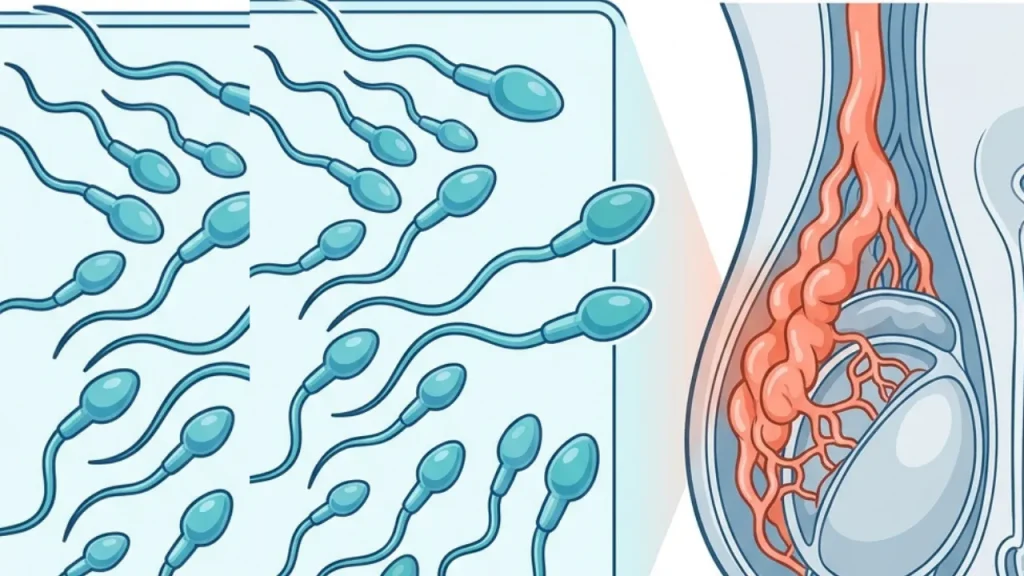
If you have just learned you have a varicocele, or you and your partner have been trying to conceive without success, you may be feeling worried. You might be asking yourself: “Is this the reason we haven’t had success?” or “Does this mean I need surgery?”
These are fair questions, and they deserve honest answers. This article explains how a varicocele may relate to fertility, why the picture is different for every man, and what steps make sense if you are concerned.
What Is a Varicocele, Briefly
A varicocele is a group of enlarged veins inside the scrotum, similar to varicose veins in the legs. They are common, usually develop on the left side, and often cause no symptoms at all.
For a fuller explanation of what a varicocele is and how it is recognized, see our guide on understanding varicocele.
How a Varicocele May Relate to Male Fertility
A varicocele can sometimes affect the testicle’s ability to produce healthy sperm. Researchers believe this may happen because the swollen veins can raise the temperature inside the scrotum slightly, which may affect sperm production over time.
This is why varicoceles are discussed as one possible factor among several when a couple is evaluating fertility concerns. Doctors and fertility specialists consider a varicocele as one piece of a larger picture, not the whole answer on its own.
It is also worth knowing that a varicocele is a common finding. Many men with a varicocele have completely normal fertility and never notice any effect at all.
Why Not Every Varicocele Affects Fertility
This is one of the most important points to understand: having a varicocele does not mean your fertility is automatically affected.
A few reasons why the relationship varies from person to person:
- Size alone does not predict impact. A larger varicocele does not automatically mean a bigger fertility concern, and a smaller one does not rule it out.
- Many men have no change in sperm health. Some men with a confirmed varicocele go on to conceive without any difficulty.
- Other factors matter too. Fertility depends on both partners, overall health, hormone levels, lifestyle, and other conditions that may or may not be present.
Because of this, no one should assume that finding a varicocele explains a fertility concern without a proper evaluation.
Semen Analysis: A Quick Word on Context
If you are being evaluated for fertility, your doctor may suggest a semen analysis, which is a laboratory test that looks at a sample of semen to check things like sperm count and movement.
A semen analysis is one piece of information among several that a doctor uses when thinking about fertility and a varicocele together. It is important to understand that:
- A single semen analysis result does not, by itself, prove that a varicocele is the cause of a fertility concern.
- Results can vary from one sample to another, which is one reason doctors are often cautious about drawing conclusions from just one test.
- Interpreting what a result means for your specific situation is something your doctor does by combining it with your exam, history, and other relevant findings.
This article does not interpret individual semen analysis results. If you have a report in hand and want to understand what it means for you, your doctor can walk through it with you directly, in the context of your full evaluation.
For more on how a varicocele itself is confirmed, see how a varicocele is diagnosed.
Why Uncertainty Is Normal, and Why Individual Assessment Matters
It is understandable to want a clear, simple answer. But fertility is rarely simple, and a varicocele is just one factor that may or may not be relevant to your situation.
Here is why an individual assessment matters so much:
- Every case is different. Two men with a similar-looking varicocele can have very different fertility pictures.
- Fertility involves both partners. A full picture often requires looking at both partners’ health, not just one factor on one side.
- Decisions should be based on your full history. This includes your exam findings, any test results, how long you’ve been trying to conceive, and your overall health.
No article, checklist, or single test can replace a conversation with a doctor who has examined you and reviewed your specific situation.
When to Seek an Individual Assessment
Consider booking an appointment if:
- You have a known or suspected varicocele and are trying to conceive without success after a reasonable period of time.
- You have had a semen analysis with results that concern you.
- You simply want to understand whether your varicocele is worth discussing in the context of family planning.
Here is where to go for the next step depending on what you need:
- To learn how a varicocele is confirmed, read how a varicocele is diagnosed.
- To understand the treatment paths that may be discussed, see varicocele treatment options.
- If you are in Dhaka and want a convenient next step, see varicocele care in Dhaka.
- To book a consultation directly, contact the clinic here.
Key Takeaways
✅ A varicocele is a possible factor in male fertility, but it is not the whole picture for everyone.
✅ Many men with a varicocele have completely normal fertility.
✅ A semen analysis is helpful context, but one result alone cannot confirm a varicocele is the cause of a fertility concern.
✅ Fertility decisions depend on an individual, couple-based assessment, not a single test or finding.
✅ If you’re concerned, a conversation with a doctor is the clearest way to understand your own situation.
Frequently Asked Questions
Does having a varicocele mean I can’t have children?
No. Many men with a varicocele have normal fertility and father children without any issue. A varicocele is only one possible factor among many.
If my semen analysis shows a low count, does that confirm the varicocele is the cause?
Not by itself. A single semen analysis result does not prove a varicocele is responsible. Your doctor will look at your full history, exam, and other relevant findings together.
Should I get treatment for my varicocele to improve my chances of having a baby?
This depends entirely on your individual situation. There is no universal recommendation that applies to every man with a varicocele. Your doctor can discuss whether treatment is relevant for you after a full assessment. Learn more about the options in our treatment guide.
How long should we try to conceive before getting checked?
This is a personal question best discussed with a doctor, since it depends on factors like age and health history for both partners. If you are concerned, there is no harm in seeking an earlier evaluation.
Can a varicocele get better or worse over time in terms of fertility impact?
This varies by individual. Rather than guessing, the most reliable approach is ongoing follow-up with your doctor, who can track any relevant changes over time.
References
- Kim DK, Kim DS, Kam SC, Lee HS, Lee WK, Song SH. Recent Guidelines and Perspectives for Varicocele: A Clinical Consensus and Recommendations from the Korean Society for Sexual Medicine and Andrology. World Journal of Men’s Health. 2025. Available at: https://www.wjmh.org/pdf/10.5534/wjmh.240290
- American Urological Association and American Society for Reproductive Medicine. Report on Varicocele and Infertility. Available at: https://www.auanet.org/documents/education/clinical-guidance/Varicocele-Archive.pdf
- AUA/ASRM Guideline. Diagnosis and Treatment of Infertility in Men, Part I. Available at: https://www.auajournals.org/doi/pdf/10.1097/JU.0000000000001521
About the Author:
Md. Salauddin Biswas works as a healthcare website SEO and content strategist, assisting doctors and clinics in converting complex medical subjects into clear, trustworthy content.
He holds an MA in Medical Anthropology from the University of Heidelberg, Germany, and an MA in Islamic History & Culture from the University of Dhaka, where he graduated with 1st Class, 1st Position.
He is a former Senior Research Associate at the James P Grant School of Public Health, BRAC University, and a published author in peer-reviewed health research. He has worked in healthcare SEO since 2017 and is based in Dhaka, Bangladesh. Learn more at salauddinbiswas.com/about/.
Medically Reviewed by:
Dr. Nazrul Islam, MBBS, MS (General Surgery)
FCPS (Surgery) · MS (Colorectal Surgery) · FACS (Fellow, American College of Surgeons)
Assistant Professor (Colorectal Surgery), Shaheed Suhrawardy Medical College & Hospital, Dhaka, Bangladesh.